Some weeks your schedule fills up quickly. Other weeks, it feels slower than expected. Inconsistent booking weeks are common for sports facilities, even when demand
If a client visit your website, ask about availability, or say they’ll book later. Then nothing happens.
In most cases, the problem is the booking process itself.
Making booking easier comes down to removing friction and giving clients a clear path from interest to confirmation.
In this article, we’ll walk through where booking tends to slow down and how to improve it.
– Booking issues often come from small points of friction
– Clear availability helps clients make faster decisions
– Fewer steps increase the chances of completion
– Simpler payment flows reduce drop-offA consistent process makes repeat bookings easier
Most clients don’t decide against booking. They just don’t finish it.
This usually happens when the process feels slow or unclear.
For example, a parent might reach out to ask about times, wait for a reply, then forget to follow up. Another client might start the process but stop when they need to enter too much information or aren’t sure what to do next.
These small delays add up and create gaps in your schedule.
Booking becomes easier when clients can immediately see what’s available.
Without that visibility, they have to ask, wait, and then decide. That delay often leads to missed bookings.
For example, when a client can view open time slots and choose a session right away, the process feels more direct. When availability isn’t clear, it creates uncertainty and slows everything down.
Clear scheduling helps clients move forward without hesitation.
The more steps involved, the less likely someone is to finish.
Clients are more likely to complete bookings when the process is short and easy to follow.
For example, if booking requires multiple pages, repeated inputs, or unnecessary details, people tend to drop off before completing it. A shorter flow that focuses only on what’s needed keeps the process moving.
Keeping things simple improves completion rates.
Clients don’t always book during business hours.
If they have to wait for a response, there’s a good chance they won’t come back to it later.
For example, a parent looking at options in the evening may be ready to book, but if they need to wait until the next day for confirmation, the moment passes.
Allowing clients to book when they’re ready helps capture that intent.
Payment is one of the most common places where bookings stop.
If pricing isn’t clear or the process feels complicated, clients hesitate.
For example, unexpected fees, unclear totals, or limited payment options can cause someone to pause. When payment is straightforward and easy to complete, clients are more likely to finish the booking.
Clarity at this stage makes a difference.
Manual coordination slows everything down.
When booking depends on messages, confirmations, and follow-ups, it creates extra steps for both your team and your clients.
For example, going back and forth to confirm a time adds friction. A more direct process allows clients to select a time and move forward without waiting.
Reducing these steps keeps the process efficient.
After a booking is made, clear communication helps reinforce the decision.
Automated confirmations, reminders, and updates keep clients informed without adding extra work.
For example, a confirmation message gives clients confidence that everything is set. A reminder before the session helps reduce no-shows.
Automation supports consistency without requiring manual effort each time.
When booking works the same way every time, clients move through it faster.
Consistency helps remove uncertainty and builds familiarity.
For example, returning clients who know exactly how to book are more likely to schedule again without hesitation. A predictable process makes repeat bookings easier.
As programs grow, managing bookings manually becomes harder to maintain.
Having a structured system in place helps keep the process consistent.
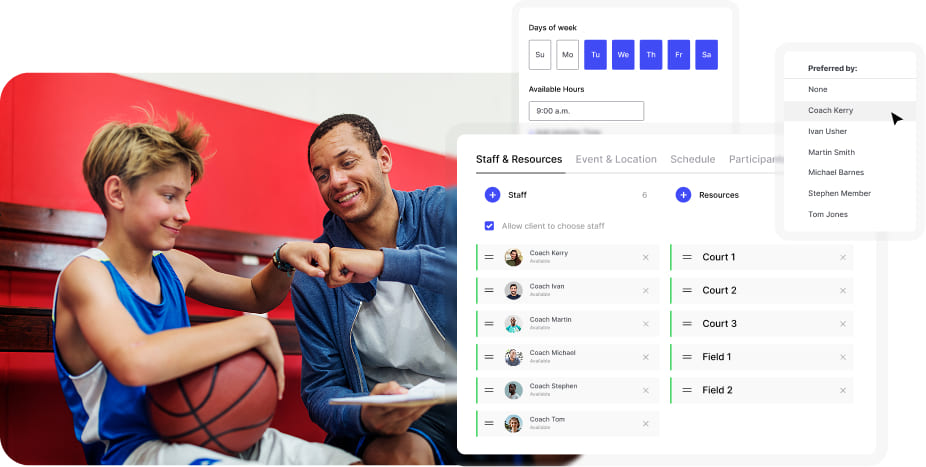
With Upper Hand, clients can view availability, book sessions, and complete payments in one place. This removes the need for back-and-forth communication and helps create a more direct booking experience.
From an operational perspective, it also connects scheduling, registrations, and communication, which helps teams stay organized across their programs.
The goal is to make booking easier to manage without adding more steps.

Some weeks your schedule fills up quickly. Other weeks, it feels slower than expected. Inconsistent booking weeks are common for sports facilities, even when demand

Think about how people book everything else. Haircuts. Appointments. Reservations. They don’t send a message and wait. They open a calendar, pick a time, and